

- HOME
- ABOUT US
- SERVICES
Information Technology & Application Services
- INDUSTRIES
- JOBS
- Resume
- Blog
- CONTACT US
- DIGITAL
For decades, cybersecurity relied on one primary concept: the network perimeter.
Firewalls, VPNs, and intrusion detection systems were designed to protect a clearly defined boundary. But in 2026, that boundary no longer exists.
Organizations now operate across:
In this distributed digital world, the traditional perimeter has dissolved.
The new perimeter is identity.
Identity and Access Management (IAM) is no longer just an IT control — it is now the foundation of modern security architecture.
Applications are no longer inside a single network. They exist across cloud providers and SaaS platforms.
Employees access systems from homes, airports, and personal devices.
Machine-to-machine communication requires identity validation beyond human users.
Vendors and partners require controlled access to internal systems.
In this reality, location-based security is ineffective.
Access must be controlled based on who (or what) is requesting it, not where it originates.
Modern IAM is no longer limited to simple login authentication. It now includes:
IAM has evolved into a comprehensive identity security framework.
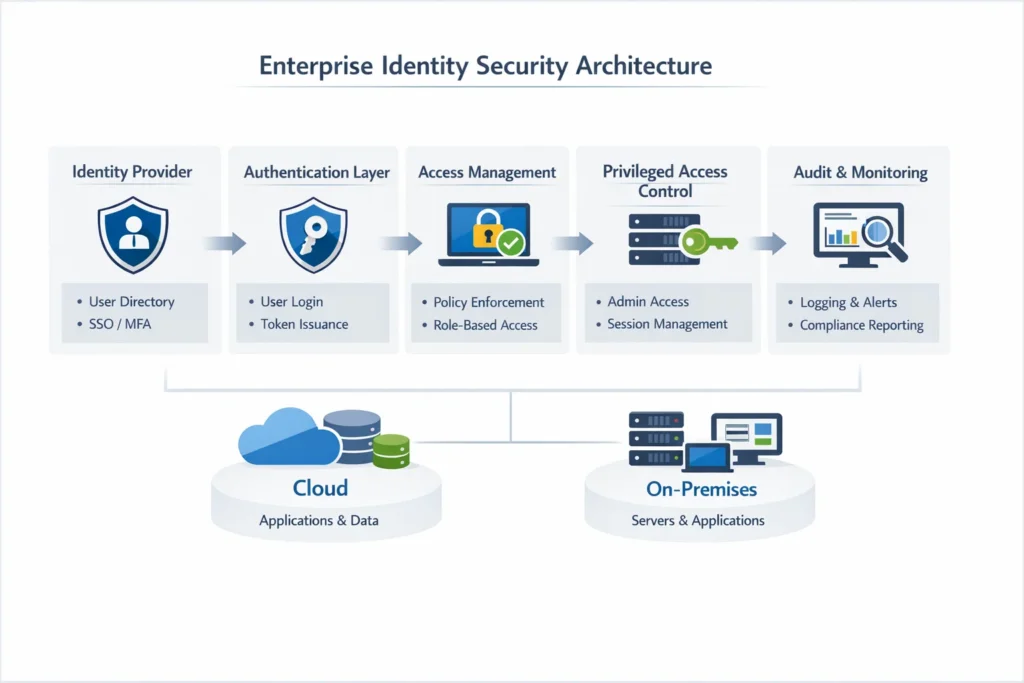
Zero Trust operates on a simple principle:
Never trust, always verify.
Identity is central to Zero Trust because:
IAM enables:
✔ Context-aware authentication
✔ Risk-based access decisions
✔ Continuous session validation
✔ Granular access controls
Without strong IAM, Zero Trust cannot function effectively.
Biometrics, hardware keys, and secure tokens are replacing passwords.
Not just employees — APIs, bots, and workloads require identity controls.
Consolidation of multiple IAM tools into centralized governance systems.
Adaptive authentication based on behavior, location, and device health.
Regulations require clear access logging and audit trails.

Strong data privacy cannot exist without data governance.
Governance ensures:
Together, privacy + governance form the foundation of compliant analytics, reporting, and digital operations.
Challenge | Business Impact |
Identity sprawl | Unmanaged access risks |
Excessive privileges | Insider threats |
Manual provisioning | Operational delays |
Shadow accounts | Compliance gaps |
Poor visibility | Audit failures |
Without strong governance, identity becomes the weakest link in security.
Consolidate identity providers and eliminate silos.
Grant only necessary permissions — nothing more.
Onboarding, role changes, and offboarding must be automated.
Track access patterns and detect anomalies early.
IAM must align with governance and audit requirements.

By 2026 and beyond:
IAM will evolve from a technical control to a strategic business enabler
In a borderless digital environment, identity is the only consistent security anchor.
Organizations that modernize IAM in 2026 will achieve:
Those that rely on legacy identity models will struggle with increasing complexity and risk.
At JPS Tech Solutions, we help enterprises design and implement modern IAM frameworks aligned with Zero Trust, compliance requirements, and business objectives
👉 Ready to make identity your strongest security perimeter? Talk to our experts today.
👉 Ready to make identity your strongest security perimeter? Talk to our experts today.